Design for Responsible AI and welfare: 2024 EiT Village

12.01.2024 – 26.01.2024, NTNU Trondheim, Norway
Course teacher (village supervisor): Sofia Papavlasopoulou
Course code: TDT4850

This was the third time we run design activities with students to establish new knowledge about the use of AI applications in public administration in Norway, focusing on the users´ need to understand the role of AI in welfare delivery processes, their key characteristics and the types of data they use, leading the way in developing human-friendly and trustworthy solutions. Participants worked alongside researchers from the AI4users project from both University of Agder (UiA) and NTNU. The purpose of this partnership was to provide participants with relevant insights, facilitate meaningful discussion, and evaluate proposed measures addressing specific challenges related to the responsible use of AI in delivering welfare services.

EiT is an obligatory course for study programmes at the master’s level at NTNU. In this course, students from different study programs come together to solve real challenges through collaboration, reflection, and shared responsibility. It works by placing diverse groups in interdisciplinary villages, where they explore problems, develop ideas, and practice communication, trust building, and constructive conflict resolution. This takes place through written and oral reflections, and structured teamwork exercises. Through this process students discover how their individual strengths become far more powerful when combined with the perspectives of others, and they learn what effective teamwork truly means in practice. The teaching takes place in courses (villages) wich each have a different focus and challenges.
Read more about EiT on NTNU´s website.

Examples of challenges:
– Developing methods for identifying the needs of different groups of citizens and caseworkers.
– Creating solution ideas or prototypes that visualize information in an understandable way.
– Evaluating alternative visualizations and their impact on decision-making processes or public acceptance.
– Increasing the efficiency of decision processes without compromising transparency.
– Respecting legal requirements while building trust in both the systems and the caseworkers who use them.

Timeline

Responsible AI – Design Challenge

11.09.2023 – 15.09.2023, Online event
16.09.2023 – 17.09.2023, In-person event – Oslo, Norway
AI4users

In September ´23, we hosted a Design Challenge on Responsible AI, where everyone was welcome to attend. The event was divided into two parts: a remote phase where the teams gained acces to the task and material, followed by a two-day in-person event where the first day consisted of prototyping and testing. On the second day, the teams presented their prototypes togheter with the reasoning that went into their design decisions to the committee as well as other participating groups.

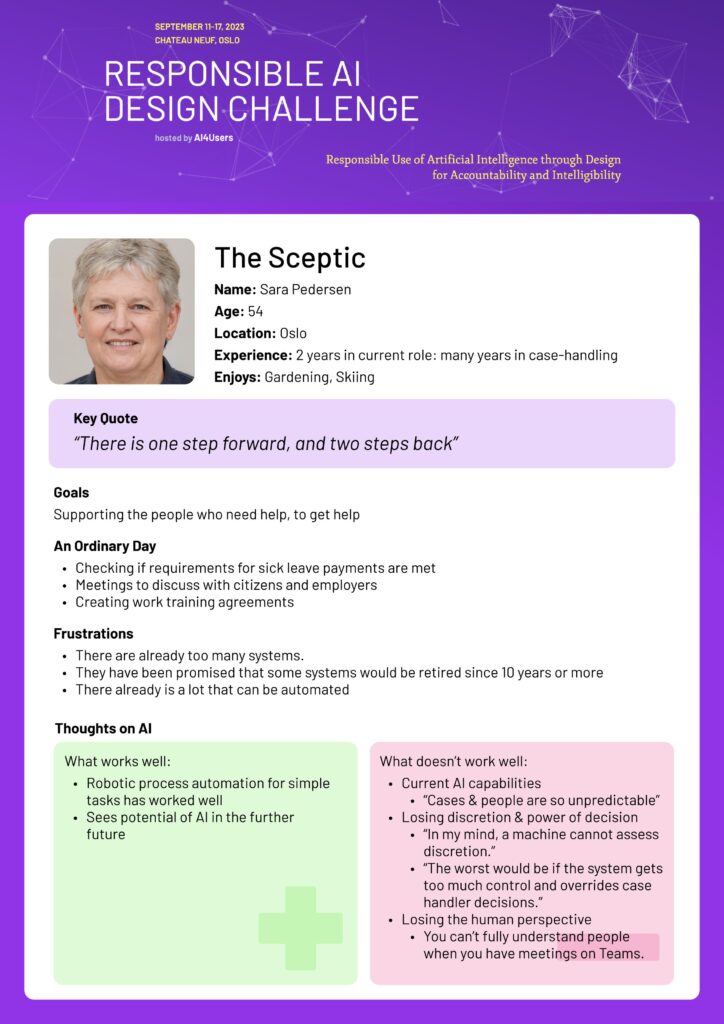
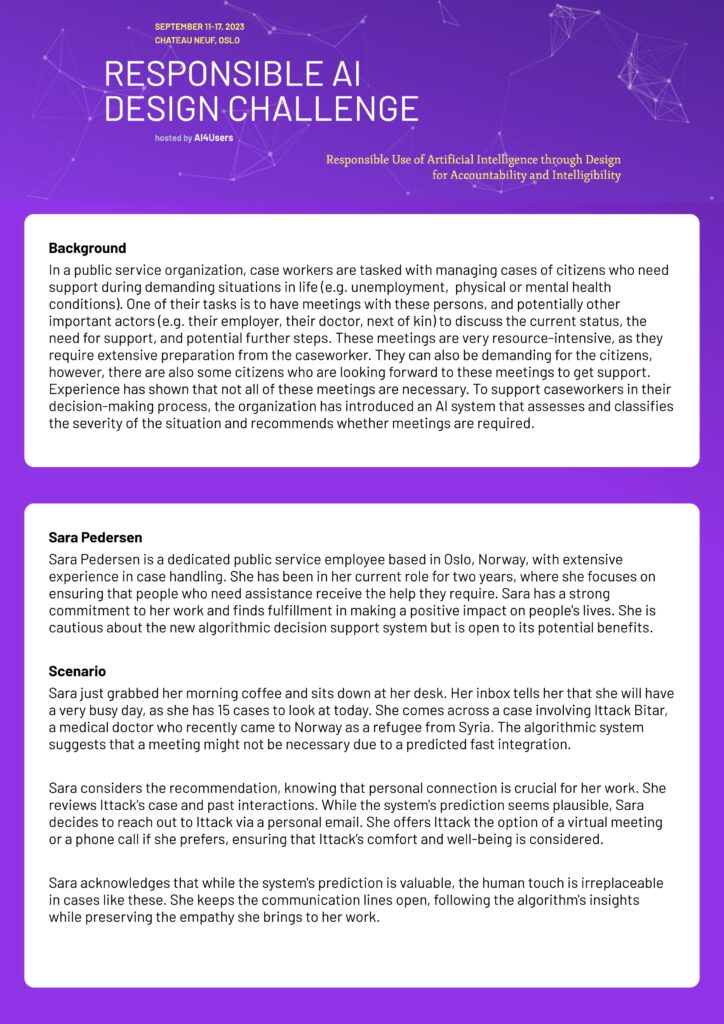
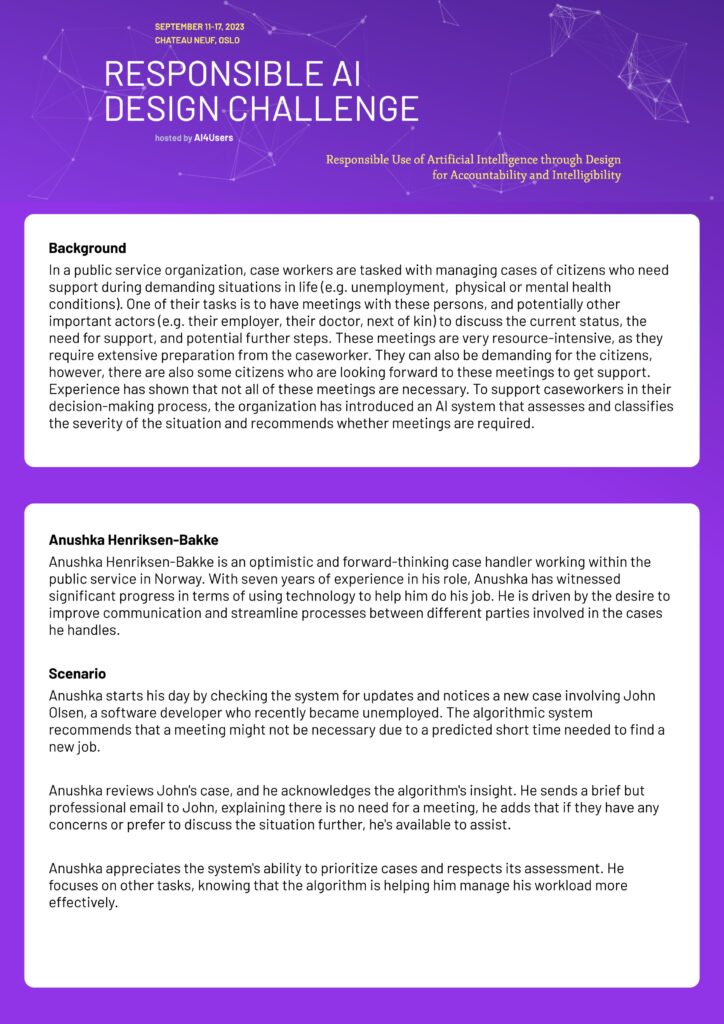
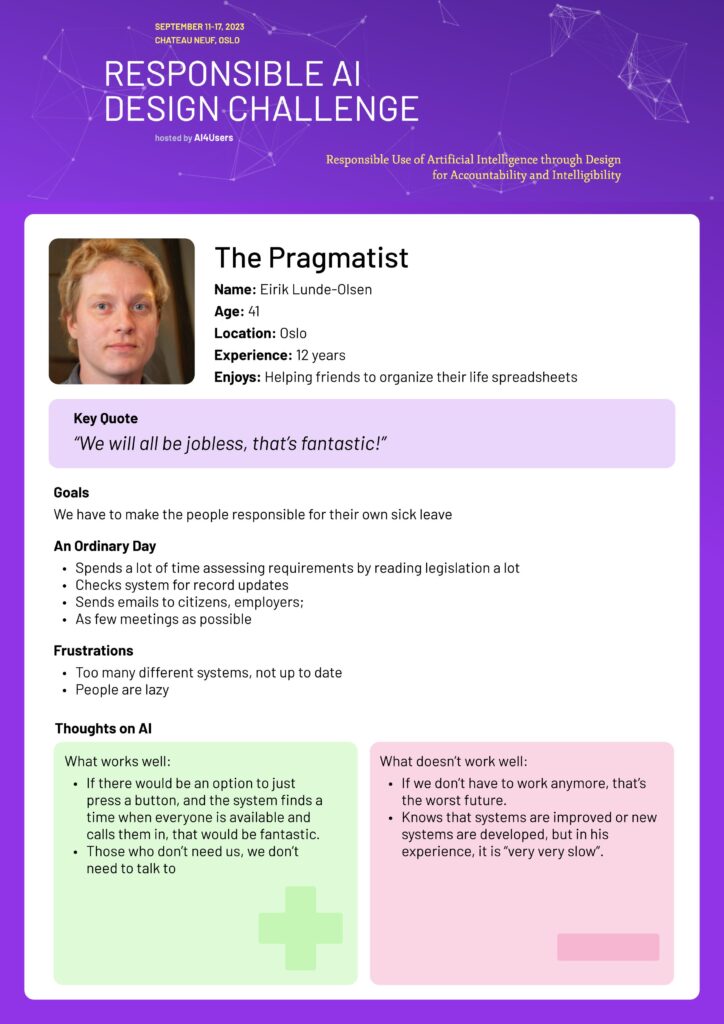
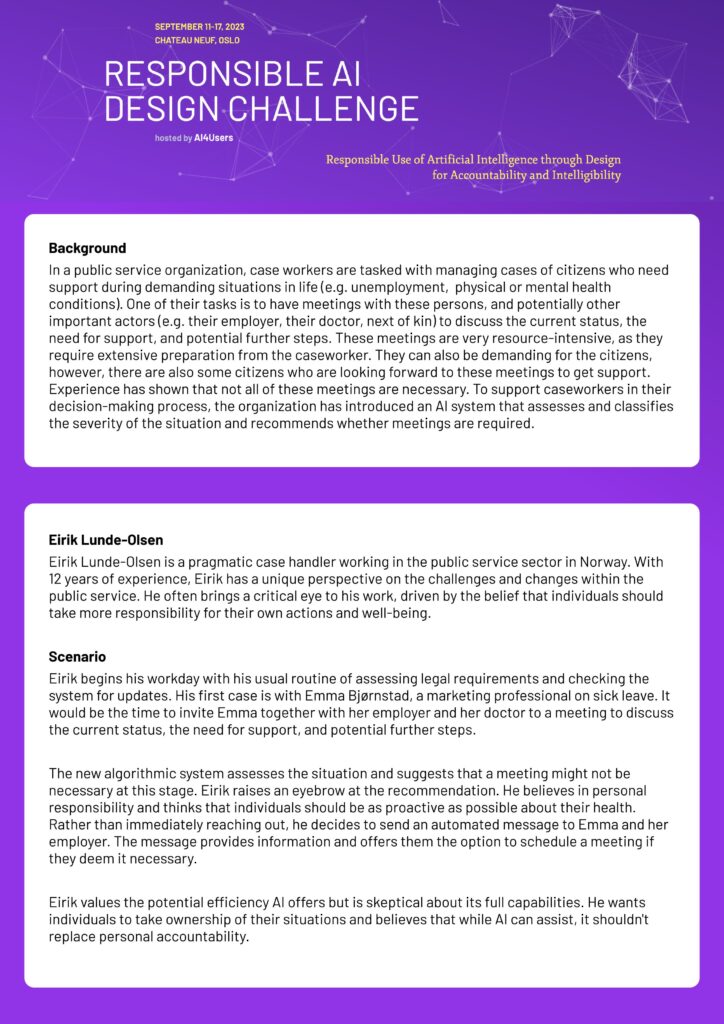
In this design challenge, the context was the use of Artificial Intelligence (AI) systems in public service organizations. The participants worked on a fictitious case in which a system is supposed to help caseworkers in their daily work within a public service organisation. The task was to design a system to help the caseworkers with their decision-making process and explore how AI can be meaningfully integrated into it. The design challenge was approached from different perspectives, e.g. with focus either on the interface or data, and the submissions ranged from simple paper-based sketches and wireframes to fully functioning prototypes.

Background

In a public service organization, case workers are tasked with managing cases of citizens who need support during demanding situations in life (e.g. unemployment, physical or mental health conditions). One of their tasks is to have meetings with these persons, and potentially other important actors (e.g. their employer, their doctor, next of kin) to discuss the current status, the need for support, and potential further steps. These meetings are very resource-intensive, as they require extensive preparation from the caseworker. They can also be demanding for the citizens, however, there are also some citizens who are looking forward to these meetings to get support. Experience has shown that not all of these meetings are necessary. To support caseworkers in their decision-making process, the organization has introduced an AI system that assesses and classifies the severity of the situation and recommends whether meetings are required.

Personas and Scenarios

Defining Human-Centered AI: a Comprehensive Review of HCAI Literature

06.09.2023 – 09.09.2023, Madrid, Spain
Stefan Schmager, Ilias Pappas, Polyxeni Vassilakopoulou

Authors

Stefan Schmager 1

Ilias Pappas 1,2

Polyxeni Vassilakopoulou 1

2 Norges teknisk-naturvitenskapelige universitet, Fakultet for informasjonsteknologi og elektroteknikk, Institutt for datateknologi og informatikk

1 Universitetet i Agder, Fakultet for samfunnsvitenskap, Institutt for informasjonssystemer

Event

Title: Mediterranean Conference on Information Systems 2023

Organizer: MCIS

Justice as Fairness: a hierarchical framework of Responsible AI principles

11.06.2023 – 16.06.2023, Kristiansand, Norway
Pouria Akbarighatar, Ilias Pappas, Polyxeni Vassilakopoulou

Authors

Pouria Akbarighatar 1

Ilias Pappas 1,2

Polyxeni Vassilakopoulou 1

2 Norges teknisk-naturvitenskapelige universitet, Fakultet for informasjonsteknologi og elektroteknikk, Institutt for datateknologi og informatikk

1 Universitetet i Agder, Fakultet for samfunnsvitenskap, Institutt for informasjonssystemer

Event

Title: European Conference on Information Systems ECIS 2023

Organizer: ECIS

Accountability in Managing Artificial Intelligence: State of the Art and a way forward for Information Systems Research

11.06.2023 – 16.06.2023, Kristiansand, Norway
Alexander Moltubakk Kempton, Elena Parmiggiani, Polyxeni Vassilakopoulou

Authors

Alexander Moltubakk Kempton 1

Elena Parmiggiani 2,3

Polyxeni Vassilakopoulou 4

1 Universitetet i Oslo, Det matematisk-naturvitenskapelige fakultet, Institutt for informatikk, DIG Digitalisering, Informasjonssystemer

2 Norges teknisk-naturvitenskapelige universitet, Fakultet for informasjonsteknologi og elektroteknikk, Institutt for datateknologi og informatikk

3 SINTEF AS, SINTEF Konsernstab

4 Universitetet i Agder, Fakultet for samfunnsvitenskap, Institutt for informasjonssystemer

Event

Title: European Conference on Information Systems ECIS 2023

Organizer: ECIS

AI Uncertainty in expert decision making: A qualitative evidence synthesis

11.06.2023 – 16.06.2023, Kristiansand, Norway
Casandra Ann Grundstrom, Pooja Mohanty, Elena Parmiggiani

Authors

Casandra Ann Grundstrom 1

Pooja Mohanty 1

Elena Parmiggiani 1,2

2 SINTEF AS, SINTEF Konsernstab

1 Norges teknisk-naturvitenskapelige universitet, Fakultet for informasjonsteknologi og elektroteknikk, Institutt for datateknologi og informatikk

Event

Title: European Conference on Information Systems ECIS 2023

Organizer: Association for Information Systems (AIS)

Podcast appearance: AI and the EU – Troubling Times Ahead or an Age of Opportunity

26.05.2023, Laboratories of Differentiated Integration in a Post-Brexit Europe
Stefan Schmager

Contributers

Stefan Schmager 1

Johan Erik Andersen

Frans af Malmborg

1 Universitetet i Agder, Fakultet for samfunnsvitenskap, Institutt for informasjonssystemer

Podcast

Title: Laboratories of Differentiated Integration in a Post-Brexit Europe
– episode 4

Organizer: Jean Monnet Centre of Excellence (JMCoE)

Link: Listen to the episode here

In this episode (4), they discuss A.I. (Artificial Intelligence) and uncover the current developments and trends related to this encroaching phenomenon. Are we facing a future where we will all succumb to ChatGPT and our critical thinking will be replaced by sporadically clever algorithms, thus leading to an inevitable downfall for academia? Should we be worried about the increased introduction of A.I. into our everyday lives, where human accountability is being replaced by unaccountable software and bots? And most importantly:
How is the EU positioning itself towards A.l. and how does it fare against global tech giants such as China and the USA? All of these issues are discussed in this episode.

Joined by Stefan Schmager, PhD Research Fellow in Information Systems at the University of Agder, and by Frans af Malmborg, PhD Research Fellow in Political Science and Management at the University of Agder.

Design for Responsible AI and welfare: 2023 EiT Village

13.01.2023 – 27.01.2023, NTNU Trondheim, Norway
Course teacher (village supervisor): Sofia Papavlasopoulou
Course code: TDT4850

This was the second time we run design activities with students to establish new knowledge about the use of AI applications in public administration in Norway, focusing on the users´ need to understand the role of AI in welfare delivery processes, their key characteristics and the types of data they use, leading the way in developing human-friendly and trustworthy solutions. Participants worked alongside researchers from the AI4users project from both University of Agder (UiA) and NTNU. The purpose of this partnership was to provide participants with relevant insights, facilitate meaningful discussion, and evaluate proposed measures addressing specific challenges related to the responsible use of AI in delivering welfare services.

EiT is an obligatory course for study programmes at the master’s level at NTNU. In this course, students from different study programs come together to solve real challenges through collaboration, reflection, and shared responsibility. It works by placing diverse groups in interdisciplinary villages, where they explore problems, develop ideas, and practice communication, trust building, and constructive conflict resolution. This takes place through written and oral reflections, and structured teamwork exercises. Through this process students discover how their individual strengths become far more powerful when combined with the perspectives of others, and they learn what effective teamwork truly means in practice. The teaching takes place in courses (villages) wich each have a different focus and challenges.
Read more about EiT on NTNU´s website.

Examples of challenges:
– Developing methods for identifying the needs of different groups of citizens and caseworkers.
– Creating solution ideas or prototypes that visualize information in an understandable way.
– Evaluating alternative visualizations and their impact on decision-making processes or public acceptance.
– Increasing the efficiency of decision processes without compromising transparency.
– Respecting legal requirements while building trust in both the systems and the caseworkers who use them.

Timeline