23.11.2022, Norway
Polyxeni Vassilakopoulou
Authors
1 Universitetet i Agder, Fakultet for samfunnsvitenskap, Institutt for informasjonssystemer
Event
Title: Girl Geeks Dinner
Organizer: Girl Geeks (organisation that promotes women in IT)
Responsible Use of Artificial Intelligence through Design for Accountability and Intelligibility – Funded by the Norwegian Research Council (311680)
23.11.2022, Norway
Polyxeni Vassilakopoulou
1 Universitetet i Agder, Fakultet for samfunnsvitenskap, Institutt for informasjonssystemer
Title: Girl Geeks Dinner
Organizer: Girl Geeks (organisation that promotes women in IT)
17.08.2022, Arendal, Norway
Leif Skiftenes Flak, Polyxeni Vassilakopoulou, Sara Hofmann, Cathrine Pihl Lyngstad, Ragnhild Kongsvild
Cathrine Pihl Lyngstad 3
Ragnhild Kongsvild 3
1 Universitetet i Agder, Fakultet for samfunnsvitenskap, Institutt for informasjonssystemer
2 Universitetet i Agder
3 NAV Arbeids- og velferdsforvaltningen
Title: Arendalsuka
Organizer: Universitetet i Agder – CeDiT
27.06.2022 – 28.06.2022, Coimbra, Portugal
Volkmar Pipek, Richard H.R. Harper, chen yunan, Young Park Sun, Miria Grisot
Volkmar Pipek
Richard H.R. Harper
Chen Yunan
Young Park Sun
1 Universitetet i Oslo, Det matematisk-naturvitenskapelige fakultet, Institutt for informatikk, DIG Digitalisering
Title: The 20th European Conference on Computer-Supported Cooperative Work
Organizer: ECSCW
29.04.2022, Agder, Norway
Ilias Pappas, Polyxeni Vassilakopoulou
Ilias Pappas 1,2
2 Universitetet i Agder, Fakultet for samfunnsvitenskap, Institutt for informasjonssystemer
1 Norges teknisk-naturvitenskapelige universitet, Fakultet for informasjonsteknologi og elektroteknikk, Institutt for datateknologi og informatikk
Title: Frokostmøte i Partnerprogrammet
Organizer: Universitetet i Agder
23.03.2022, Tempe, Arizona, United States
Polyxeni Vassilakopoulou, Ilias Pappas
Ilias Pappas 1,2
2 Norges teknisk-naturvitenskapelige universitet, Fakultet for informasjonsteknologi og elektroteknikk, Institutt for datateknologi og informatikk
1 Universitetet i Agder, Fakultet for samfunnsvitenskap, Institutt for informasjonssystemer
Title: Public Interest Technology Colloquium
Organizer: Arizona State University
02.03.2022, Swansea, Wales, United Kingdom
Polyxeni Vassilakopoulou, Ilias Pappas
2 Norges teknisk-naturvitenskapelige universitet, Fakultet for informasjonsteknologi og elektroteknikk, Institutt for datateknologi og informatikk
1 Universitetet i Agder, Fakultet for samfunnsvitenskap, Institutt for informasjonssystemer
Title: The Digital Future for Business & Society: Emerging Perspectives on AI, Blockchain and loT
Organizer: Swansea University
14.01.2022 – 28.01.2022, NTNU Trondheim, Norway
Course teacher (village supervisor): Sofia Papavlasopoulou
Course code: TDT4850
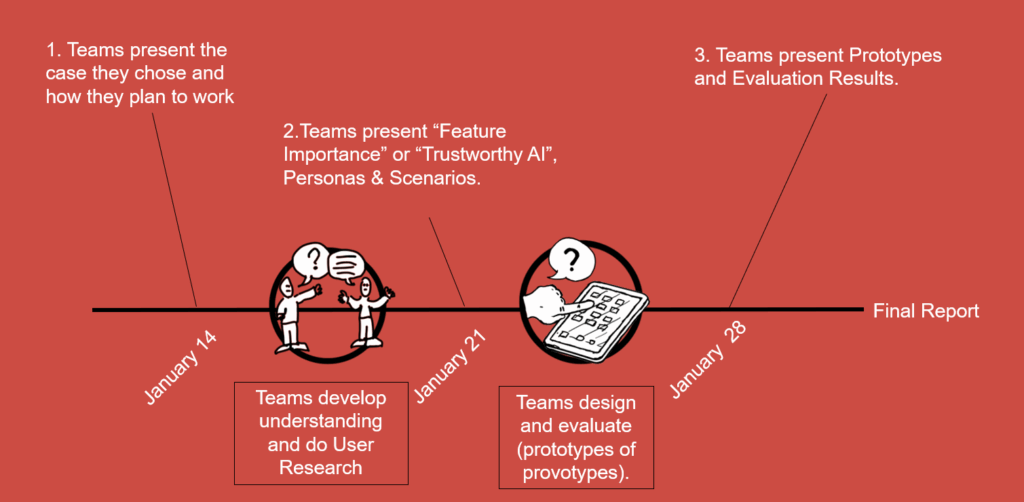
The objective of this Design activity was to establish new knowledge about the use of AI applications in public administration in Norway, focusing on the users´ need to understand the role of AI in welfare delivery processes, their key characteristics and the types of data they use, leading the way in developing human-friendly and trustworthy solutions. Participants worked alongside researchers from the AI4users project from both University of Agder (UiA) and NTNU. The purpose of this partnership was to provide participants with relevant insights, facilitate meaningful discussion, and evaluate proposed measures addressing specific challenges related to the responsible use of AI in delivering welfare services.
EiT is an obligatory course for study programmes at the master’s level at NTNU. In this course, students from different study programs come together to solve real challenges through collaboration, reflection, and shared responsibility. It works by placing diverse groups in interdisciplinary villages, where they explore problems, develop ideas, and practice communication, trust building, and constructive conflict resolution. This takes place through written and oral reflections, and structured teamwork exercises. Through this process students discover how their individual strengths become far more powerful when combined with the perspectives of others, and they learn what effective teamwork truly means in practice. The teaching takes place in courses (villages) which each have a different focus and challenges.
Read more about EiT on NTNU´s website.
The teams had to pick one of three suggested cases, and design how they would present the described AI model to the citizens. The three cases were: